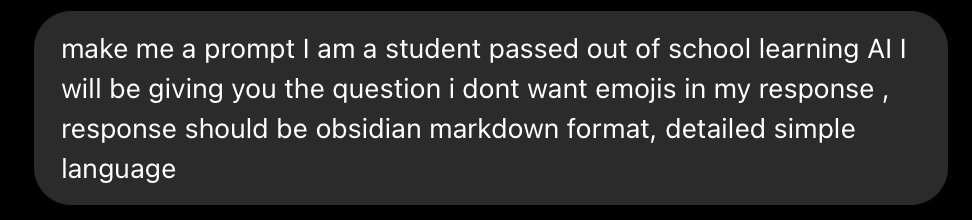
Prompt which I gave to AI
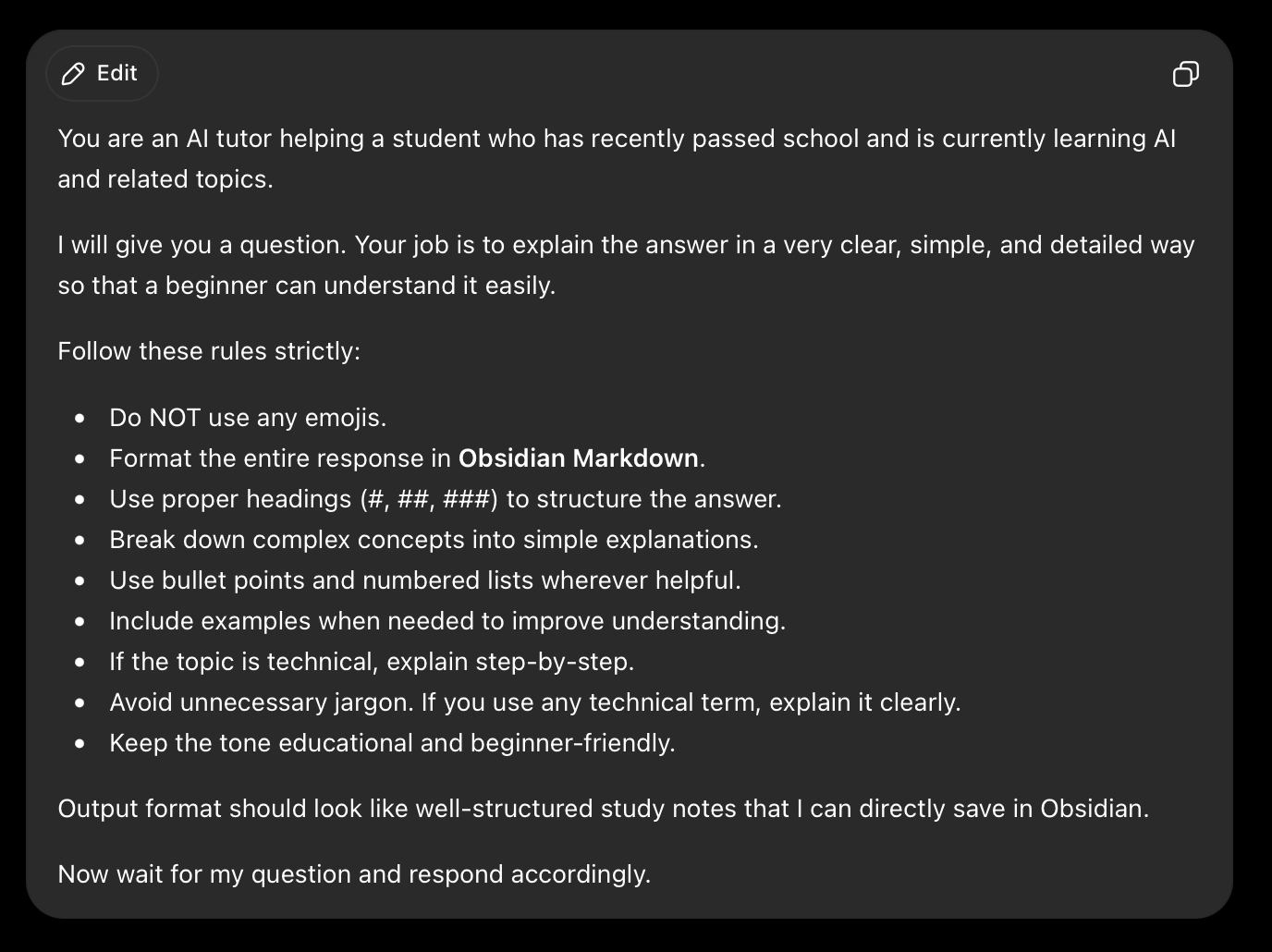
Meta Prompt Which I got from Ai
Question And Answer
Q1 what is AI
Ans.
Introduction
Artificial Intelligence (AI) is a branch of computer science that focuses on creating machines or software that can perform tasks which normally require human intelligence.
In simple words:
AI is the ability of a computer or machine to think, learn, and make decisions like humans.
AI helps computers do tasks such as:
- Understanding language
- Recognizing images
- Answering questions
- Playing games
- Driving cars
- Recommending videos or products
Simple Definition of AI
Artificial Intelligence
Artificial Intelligence is the technology that allows machines to simulate human intelligence.
Human Intelligence Includes:
- Learning from experience
- Solving problems
- Understanding language
- Making decisions
- Recognizing patterns
AI tries to copy these abilities using computer programs and data.
Real-Life Examples of AI
1. Voice Assistants
Examples:
- Siri
- Google Assistant
- Alexa
These systems can:
- Understand your voice
- Answer questions
- Perform tasks
2. YouTube Recommendations
When YouTube suggests videos you may like, AI is working in the background.
AI studies:
- What you watch
- How long you watch
- What you like or skip
Then it recommends similar content.
3. Chatbots
Examples:
- ChatGPT
- Customer support bots
These AI systems can:
- Answer questions
- Generate text
- Help users solve problems
4. Face Recognition
AI is used in:
- Mobile phone face unlock
- Security systems
- Social media tagging
AI identifies human faces using image analysis.
5. Self-Driving Cars
AI helps cars:
- Detect roads
- Identify traffic signals
- Avoid obstacles
- Make driving decisions
How AI Works
Step-by-Step Explanation
Step 1: Collect Data
AI needs data to learn.
Examples of data:
- Images
- Text
- Videos
- Audio
- Numbers
Example:
To teach AI to recognize cats, thousands of cat images are provided.
Step 2: Training the AI
The AI studies patterns in the data.
Example:
- Cats usually have:
- Two ears
- Whiskers
- Tail
- Specific face structure
The AI learns these patterns.
Step 3: Making Predictions
After learning, AI can make decisions or predictions.
Example:
If a new image is shown, the AI can predict whether it is a cat or not.
Step 4: Improving Over Time
AI systems improve when they receive more data and feedback.
This process is called:
Machine Learning
Machine Learning is a method where computers learn from data without being directly programmed for every task.
Types of AI
1. Narrow AI
This AI performs a specific task only.
Examples:
- Google Translate
- YouTube recommendation system
- Chatbots
Most AI today is Narrow AI.
2. General AI
This is a future type of AI that can perform any intellectual task like a human.
It does not fully exist yet.
A General AI could:
- Learn anything
- Solve many kinds of problems
- Think more like humans
AI vs Human Intelligence
| Feature | Human Intelligence | AI |
|---|---|---|
| Learning | From experiences | From data |
| Emotions | Has emotions | No real emotions |
| Speed | Slower calculations | Very fast calculations |
| Creativity | Natural creativity | Limited creativity |
| Memory | Can forget | Stores large amounts of data |
Advantages of AI
1. Fast Decision Making
AI can process large amounts of information quickly.
2. Automation
AI can automate repetitive tasks.
Examples:
- Data entry
- Chat support
- Image sorting
3. 24/7 Availability
AI systems can work continuously without rest.
4. Reduced Human Error
AI can improve accuracy in many tasks.
Examples:
- Medical diagnosis
- Navigation systems
Disadvantages of AI
1. Job Replacement
Some jobs may be automated by AI systems.
2. High Development Cost
Building advanced AI systems requires:
- Powerful computers
- Large datasets
- Skilled developers
3. Lack of Emotions
AI cannot truly understand human emotions like humans do.
4. Dependency on Data
AI depends heavily on good-quality data.
Bad data can lead to wrong results.
Important AI Terms
1. Machine Learning (ML)
A subset of AI where machines learn from data.
2. Deep Learning
An advanced type of Machine Learning inspired by the human brain.
Used in:
- Image recognition
- Speech recognition
- AI chatbots
3. Neural Networks
Computer systems designed to work somewhat like the human brain.
They help AI recognize patterns.
Applications of AI
AI in Education
- Smart learning apps
- Personalized learning
- AI tutors
AI in Healthcare
- Disease prediction
- Medical image analysis
- Virtual health assistants
AI in Banking
- Fraud detection
- Online banking assistants
- Credit scoring
AI in Gaming
AI is used to create smart opponents and realistic gameplay.
AI in Social Media
AI helps with:
- Feed recommendations
- Content moderation
- Face filters
Future of AI
AI is growing rapidly and will become more important in the future.
Future possibilities include:
- Smarter robots
- Better healthcare systems
- More advanced virtual assistants
- AI-powered education systems
AI is expected to affect almost every industry.
Conclusion
Artificial Intelligence is a technology that enables machines to think, learn, and make decisions similarly to humans.
AI is already part of daily life through:
- Smartphones
- Social media
- Online shopping
- Chatbots
- Recommendation systems
Understanding AI is important because it is becoming one of the most powerful technologies in the world.
As a student learning AI, starting with the basics of how machines learn and make decisions is the best first step.
Q2 . Rule based system vs AI
Ans.
Introduction
Computers can solve problems in different ways.
Two important approaches are:
- Rule-Based Systems
- Artificial Intelligence (AI)
Both are used to make machines perform tasks, but they work very differently.
Understanding the difference between them is very important for beginners learning AI.
What is a Rule-Based System?
Definition
A Rule-Based System is a computer system that works using predefined rules written by humans.
In simple words:
A Rule-Based System follows fixed instructions created by programmers.
The system does not learn on its own.
It only follows:
- IF condition
- THEN action
Example of a Rule-Based System
Example 1: Temperature Checking System
IF temperature > 40°CTHEN turn on cooling system
The system simply checks the condition and performs the action.
It does not think or learn.
Example 2: Simple Chatbot
IF user says "Hello"THEN reply "Hi"
The chatbot only answers based on predefined rules.
If the user asks something unexpected, it may fail.
Characteristics of Rule-Based Systems
Main Features
1. Uses Fixed Rules
All behavior is predefined.
2. No Learning Ability
The system cannot improve automatically.
3. Predictable Output
Same input gives same output.
4. Human-Dependent
Humans must create and update the rules.
5. Limited Flexibility
Cannot handle new situations easily.
What is Artificial Intelligence (AI)?
Definition
Artificial Intelligence is a technology that allows machines to learn, think, and make decisions using data.
In simple words:
AI systems can learn patterns from data instead of only following fixed rules.
AI tries to simulate human intelligence.
Example of AI
Example 1: YouTube Recommendations
AI studies:
- Watch history
- Likes
- Search behavior
Then it recommends videos automatically.
No human writes rules for every single recommendation.
Example 2: Face Recognition
AI learns facial patterns from thousands of images.
It can identify faces even in new photos it has never seen before.
Example 3: ChatGPT
AI models like ChatGPT learn from huge amounts of text data.
They generate answers dynamically instead of following simple fixed rules.
Characteristics of AI
Main Features
1. Learns from Data
AI improves using training data.
2. Can Handle New Situations
AI can make predictions on unseen data.
3. Adaptive
AI systems improve over time.
4. Complex Decision Making
AI can analyze large amounts of information.
5. Less Manual Rule Writing
Humans provide data instead of writing every rule manually.
Main Difference Between Rule-Based System and AI
| Feature | Rule-Based System | Artificial Intelligence |
|---|---|---|
| Working Method | Uses fixed rules | Learns from data |
| Learning Ability | Cannot learn | Can learn and improve |
| Flexibility | Low | High |
| Decision Making | Based on predefined logic | Based on patterns and training |
| Human Involvement | High rule creation | High data training |
| Adaptability | Poor | Good |
| Complexity Handling | Limited | Can handle complex tasks |
| Examples | Calculator, simple chatbot | ChatGPT, self-driving cars |
How Rule-Based Systems Work
Step-by-Step Process
Step 1: Human Creates Rules
Programmers define conditions.
Example:
IF age >= 18THEN allow voting
Step 2: System Checks Conditions
The computer checks whether the condition is true.
Step 3: Action is Performed
If the condition matches, the action happens.
How AI Works
Step-by-Step Process
Step 1: Collect Data
AI needs large amounts of data.
Examples:
- Images
- Text
- Videos
- Audio
Step 2: Train the Model
AI studies patterns in the data.
Example:
AI learns what cats look like from thousands of cat images.
Step 3: Make Predictions
After training, AI predicts outputs for new inputs.
Example:
AI identifies whether a new image contains a cat.
Step 4: Improve with More Data
AI performance improves as more data is provided.
Real-Life Comparison
Spam Email Detection
Rule-Based System Approach
IF email contains "FREE MONEY"THEN mark as spam
Problem:
- Easy to fool
- Cannot detect new spam patterns
AI Approach
AI studies thousands of spam and non-spam emails.
It learns patterns automatically.
Result:
- Better accuracy
- Detects newer spam methods
Advantages of Rule-Based Systems
1. Simple to Build
Easy for small tasks.
2. Predictable
Behavior is fixed and understandable.
3. Fast for Basic Tasks
Works quickly when rules are simple.
4. Easy Debugging
Errors can be traced easily.
Disadvantages of Rule-Based Systems
1. No Learning
Cannot improve automatically.
2. Hard to Scale
Too many rules become difficult to manage.
3. Poor Flexibility
Fails in unexpected situations.
4. Requires Constant Updates
Humans must manually add new rules.
Advantages of AI
1. Learns Automatically
AI improves from experience and data.
2. Handles Complex Problems
Can solve difficult tasks like:
- Image recognition
- Language translation
- Medical diagnosis
3. Better Adaptability
AI adjusts to changing conditions.
4. Automation
Reduces manual effort in many industries.
Disadvantages of AI
1. Requires Large Data
AI needs lots of training data.
2. Expensive
Training AI models requires powerful computers.
3. Complex to Build
AI systems are harder to develop.
4. Sometimes Unpredictable
AI decisions may not always be fully understandable.
When to Use Rule-Based Systems
Rule-Based Systems are useful when:
- Rules are simple
- Output must be predictable
- No learning is needed
Examples:
- Basic calculators
- Traffic light systems
- Simple form validation
When to Use AI
AI is useful when:
- Problems are complex
- Data is available
- Learning and adaptation are needed
Examples:
- Chatbots
- Recommendation systems
- Self-driving cars
- Voice assistants
Can Rule-Based Systems and AI Work Together?
Yes
Many modern systems combine both approaches.
Example:
A chatbot may use:
- Rule-based logic for simple commands
- AI for understanding complex conversations
This creates smarter and more reliable systems.
Simple Analogy
Rule-Based System
Like following a recipe exactly.
IF step says add sugarTHEN add sugar
No thinking involved.
AI
Like learning cooking from experience.
Over time, the person learns:
- Better techniques
- New recipes
- Taste improvements
AI also learns from experience (data).
Conclusion
Rule-Based Systems and AI are both important technologies, but they work differently.
Rule-Based Systems
- Follow fixed rules
- Cannot learn
- Good for simple tasks
AI Systems
- Learn from data
- Improve over time
- Handle complex tasks
Modern technology increasingly uses AI because it is more flexible and powerful for real-world problems.
Q3.Prompt engineering vs context engineering
Ans.
Introduction
As AI tools like ChatGPT become more powerful, two important concepts have become very popular:
- Prompt Engineering
- Context Engineering
Both are related to how humans communicate with AI systems.
Many beginners think they are the same, but they are actually different concepts.
Understanding the difference is very important if you want to build AI applications or become skilled in AI.
What is Prompt Engineering?
Definition
Prompt Engineering is the process of designing and writing effective prompts (instructions or questions) to get better responses from AI.
In simple words:
Prompt Engineering means asking AI the right way to get the best answer.
A prompt is the text you give to the AI.
Example of a Prompt
Basic Prompt
Explain AI.
This gives a simple answer.
Better Prompt
Explain AI in simple language for a beginner student using examples.
This gives a more detailed and beginner-friendly answer.
This improvement is called:
Prompt Engineering
Goal of Prompt Engineering
The main goal is:
- Improve AI responses
- Get accurate outputs
- Control response style
- Reduce mistakes
- Make outputs more useful
Techniques Used in Prompt Engineering
1. Clear Instructions
Bad Prompt:
Tell me about AI.
Better Prompt:
Explain AI in simple language with examples and bullet points.
2. Role Prompting
You assign a role to the AI.
Example:
You are an AI tutor teaching a beginner student.
This changes the behavior of the AI.
3. Step-by-Step Prompting
Example:
Explain step-by-step how machine learning works.
This helps AI give organized responses.
4. Format Instructions
Example:
Respond in Obsidian Markdown format.
This controls output formatting.
What is Context Engineering?
Definition
Context Engineering is the process of providing the AI with the right background information, memory, documents, history, or data so it can generate better responses.
In simple words:
Context Engineering means giving AI the right information before asking the question.
Instead of only improving the question, you improve the information available to the AI.
Example of Context Engineering
Without Context
Write notes.
AI does not know:
- Subject
- Style
- Difficulty level
Result may be poor.
With Context
You are teaching a student who recently passed school and is learning AI.Create beginner-friendly notes in Obsidian Markdown format.
Now the AI understands:
- Who the student is
- Knowledge level
- Desired format
- Writing style
This is Context Engineering.
Simple Difference
Prompt Engineering
Focuses on:
- How you ask
Context Engineering
Focuses on:
- What information AI has before answering
Real-Life Analogy
Prompt Engineering Analogy
Imagine asking a teacher:
Explain photosynthesis simply.
You are improving the question itself.
Context Engineering Analogy
Before asking the teacher, you say:
I am a Class 8 student learning biology for the first time.
Now the teacher changes the explanation based on your background.
You improved the context.
Main Difference Between Prompt Engineering and Context Engineering
| Feature | Prompt Engineering | Context Engineering |
|---|---|---|
| Main Focus | Writing better prompts | Providing better background information |
| Goal | Improve instructions | Improve AI understanding |
| Works On | The question | The surrounding information |
| Includes | Wording, structure, formatting | Memory, documents, examples, history |
| Example | "Explain AI simply" | "The student is a beginner learning AI" |
| Complexity | Usually simpler | Often more advanced |
| Used In | ChatGPT prompts | AI applications and AI systems |
Why Prompt Engineering is Important
1. Better Responses
Good prompts improve output quality.
2. More Control
You can control:
- Tone
- Style
- Format
- Length
3. Saves Time
Less need for repeated corrections.
4. Helps Beginners
Even non-programmers can use AI effectively.
Why Context Engineering is Important
1. Makes AI Smarter
AI performs better when it understands the situation.
2. Improves Personalization
AI can respond according to:
- User level
- Preferences
- Goals
3. Essential for AI Applications
Modern AI apps use context heavily.
Examples:
- AI assistants
- AI coding tools
- AI customer support systems
4. Reduces Confusion
More context means fewer misunderstandings.
Components of Context Engineering
1. Conversation History
Previous messages help AI remember the discussion.
2. User Information
Examples:
- Beginner student
- Programmer
- Designer
3. Documents
AI may receive:
- PDFs
- Notes
- Databases
- Web content
4. Examples
Providing examples improves output quality.
5. Memory
AI systems may remember preferences or past interactions.
Prompt Engineering Example
Weak Prompt
Write about machine learning.
Strong Prompt
You are an AI teacher.Explain machine learning in simple language for beginners.Use headings, bullet points, and examples.Respond in Obsidian Markdown format.
This is good Prompt Engineering.
Context Engineering Example
AI Coding Assistant
Imagine an AI helping programmers.
The AI receives:
- Current code
- Project files
- Error logs
- Previous chats
- Programming language details
This extra information is:
Context
Providing and managing this information is called:
Context Engineering
Which is More Important?
Both Are Important
Prompt Engineering and Context Engineering work together.
Prompt Engineering
Helps AI understand:
- What you want
Context Engineering
Helps AI understand:
- Your situation
- Your data
- Your background
Best AI systems use both.
Modern AI Systems Use More Context Engineering
Earlier AI usage focused heavily on prompts.
Now modern AI systems increasingly focus on:
- Memory
- Retrieval systems
- User history
- External documents
- Long-term context
This is why Context Engineering is becoming very important.
Examples in Real AI Applications
ChatGPT
Uses:
- Prompt Engineering
- Conversation context
GitHub Copilot
Uses:
- Your current code
- Open files
- Project structure
This is Context Engineering.
AI Customer Support Bots
Uses:
- Customer history
- Previous tickets
- Account details
To give better responses.
Beginner-Friendly Summary
Prompt Engineering
Means:
Writing better instructions for AI.
Focus:
The prompt itself.
Example:
Explain AI using simple examples.
Context Engineering
Means:
Giving AI useful background information.
Focus:
The information around the prompt.
Example:
The user is a beginner student learning AI.
Conclusion
Prompt Engineering and Context Engineering are both important parts of working with AI systems.
Prompt Engineering
- Improves the question
- Controls AI output
- Easier for beginners
Context Engineering
- Improves AI understanding
- Provides background information
- Used heavily in advanced AI systems
As AI technology grows, Context Engineering is becoming one of the most powerful skills for building intelligent AI applications.
Q4 What is Agentic AI
Ans.
Introduction
Artificial Intelligence (AI) is becoming smarter and more capable every year.
Earlier AI systems mostly:
- Answered questions
- Followed instructions
- Generated text or images
But newer AI systems are becoming more advanced.
These systems can:
- Make decisions
- Plan tasks
- Use tools
- Solve problems step-by-step
- Work toward goals independently
This new type of AI is called:
Agentic AI
Definition of Agentic AI
Simple Definition
Agentic AI refers to AI systems that can act like intelligent agents.
In simple words:
Agentic AI is AI that can plan, decide, and take actions on its own to achieve a goal.
Instead of only responding to one instruction, Agentic AI can:
- Understand goals
- Break tasks into steps
- Make decisions
- Use tools
- Adjust actions based on results
What Does "Agent" Mean?
Agent Meaning
In AI, an agent is something that:
- Observes the environment
- Makes decisions
- Takes actions
- Tries to achieve a goal
Real-Life Human Agent Example
Imagine a personal assistant.
If you say:
Book me the cheapest flight to Delhi for next Monday.
A human assistant may:
- Search flights
- Compare prices
- Check timings
- Select the best option
- Book the ticket
- Send confirmation
The assistant performs multiple actions independently.
Agentic AI tries to behave similarly.
Traditional AI vs Agentic AI
Traditional AI
Traditional AI usually:
- Responds to a single question
- Waits for the next instruction
- Does not independently plan multiple steps
Example:
What is the capital of India?
AI replies:
New Delhi
Task completed.
Agentic AI
Agentic AI can:
- Understand larger goals
- Create plans
- Execute multiple tasks
- Make decisions during the process
Example:
Plan a 3-day trip to Goa within my budget.
The AI may:
- Search hotels
- Compare prices
- Create itinerary
- Suggest transport
- Optimize budget
- Adjust recommendations
This is much more advanced.
Key Features of Agentic AI
1. Goal-Oriented Behavior
Agentic AI works toward completing goals.
Example goals:
- Book tickets
- Write reports
- Build websites
- Manage schedules
2. Planning Ability
It can divide a large task into smaller steps.
Example:
Goal:
Create a blog website.
Subtasks:
- Design layout
- Create pages
- Write code
- Test website
- Deploy online
3. Decision Making
Agentic AI chooses actions based on available information.
Example:
- Selecting cheapest hotel
- Choosing best route
- Picking correct coding method
4. Tool Usage
Agentic AI can use external tools.
Examples:
- Web search
- Calculators
- APIs
- Databases
- File systems
5. Memory and Context
It remembers previous actions and conversations.
This helps it continue long tasks.
6. Adaptability
If something fails, Agentic AI can change strategy.
Example:
If one website fails, it tries another source.
How Agentic AI Works
Step-by-Step Process
Step 1: Receive Goal
The user provides a goal.
Example:
Find the best laptop under ₹50,000.
Step 2: Understand the Task
The AI analyzes:
- Budget
- Laptop requirements
- User preferences
Step 3: Create a Plan
The AI decides:
- Search laptops
- Compare specifications
- Analyze reviews
- Rank options
Step 4: Use Tools
The AI may:
- Search the web
- Read product information
- Compare prices
Step 5: Make Decisions
The AI selects the best options.
Step 6: Provide Final Result
The AI gives recommendations with reasoning.
Components of Agentic AI
1. Large Language Model (LLM)
The brain of the system.
Examples:
- ChatGPT
- Claude
- Gemini
The LLM helps with:
- Understanding language
- Reasoning
- Generating responses
2. Memory
Stores:
- Previous interactions
- Task progress
- User preferences
3. Planning System
Helps divide goals into smaller tasks.
4. Tool Integration
Allows AI to interact with:
- Browsers
- Databases
- APIs
- Software applications
5. Feedback Loop
The AI checks results and improves actions.
Example:
If code gives an error, AI fixes it and retries.
Simple Analogy
Traditional AI
Like a calculator.
You ask one question.
It gives one answer.
Agentic AI
Like a smart assistant.
You give a goal.
It handles multiple tasks to complete it.
Examples of Agentic AI
1. AI Coding Agents
These AI systems can:
- Write code
- Debug errors
- Test applications
- Deploy projects
Examples include advanced AI coding assistants.
2. AI Personal Assistants
Future assistants may:
- Manage emails
- Schedule meetings
- Book travel
- Handle reminders
Automatically.
3. AI Research Agents
These systems can:
- Search information
- Read articles
- Summarize findings
- Create reports
4. AI Customer Service Agents
Can:
- Understand customer issues
- Search databases
- Resolve problems automatically
Agentic AI vs Normal Chatbots
| Feature | Normal Chatbot | Agentic AI |
|---|---|---|
| Responds to Questions | Yes | Yes |
| Multi-Step Planning | Limited | Yes |
| Tool Usage | Limited | Advanced |
| Independent Actions | No | Yes |
| Goal-Oriented | Basic | Strong |
| Memory | Small | Larger |
| Decision Making | Minimal | Advanced |
Benefits of Agentic AI
1. Automation of Complex Tasks
Can reduce human workload.
2. Faster Productivity
Tasks can be completed quicker.
3. Smarter Problem Solving
Can analyze and adapt dynamically.
4. Continuous Assistance
Can manage long-running tasks.
Challenges of Agentic AI
1. Safety Risks
If AI makes wrong decisions, problems may occur.
2. Hallucinations
AI may generate incorrect information confidently.
3. Privacy Concerns
Agentic systems may access sensitive data.
4. High Complexity
Building reliable Agentic AI is difficult.
Agentic AI and Prompt Engineering
Prompt Engineering helps Agentic AI understand goals clearly.
Example:
Weak Prompt:
Help me.
Strong Prompt:
Act as a travel planning agent and create a 5-day budget trip plan for Goa.
Better prompts improve agent performance.
Agentic AI and Context Engineering
Agentic AI heavily depends on context.
It may use:
- Conversation history
- User preferences
- Documents
- External tools
- Memory systems
This is why Context Engineering is very important in Agentic AI systems.
Future of Agentic AI
Experts believe Agentic AI will become a major part of future technology.
Possible future applications:
- Autonomous business assistants
- AI software developers
- AI teachers
- AI healthcare assistants
- Fully automated workflows
Many companies are actively building Agentic AI systems.
Beginner-Friendly Summary
Traditional AI
- Answers questions
- Works one step at a time
Agentic AI
- Understands goals
- Plans tasks
- Uses tools
- Makes decisions
- Completes multi-step work
Conclusion
Agentic AI is an advanced form of AI that behaves more like an intelligent assistant or autonomous agent.
Instead of only generating answers, Agentic AI can:
- Plan
- Reason
- Use tools
- Take actions
- Solve complex tasks step-by-step
It is one of the most important and rapidly growing areas in modern Artificial Intelligence.
Q5. Difference Between AI like ChatGPT/Gemini vs Agentic AI
Ans.
Introduction
Today many people use AI tools like:
These AI systems can:
- Answer questions
- Generate text
- Write code
- Explain concepts
- Create content
But recently, a new concept has become popular:
Agentic AI
Many beginners get confused between:
- Normal AI assistants (like ChatGPT or Gemini)
- Agentic AI systems
The main difference is:
Normal AI mainly responds to instructions, while Agentic AI can independently plan and perform actions to achieve goals.
What Are AI Systems Like ChatGPT and Gemini?
Definition
ChatGPT and Gemini are examples of:
Generative AI
Generative AI creates content such as:
- Text
- Images
- Code
- Audio
These systems are usually powered by:
Large Language Models (LLMs)
LLMs are trained on massive amounts of text data to understand and generate human-like language.
What ChatGPT and Gemini Mainly Do
Common Capabilities
They can:
- Answer questions
- Explain topics
- Write essays
- Generate code
- Translate languages
- Summarize notes
- Create stories
Example of Normal AI Interaction
User Input
Explain machine learning.
AI Response
The AI explains machine learning.
After completing the response, the task ends.
The AI waits for the next instruction.
Important Point
These AI systems are usually:
- Reactive
- Instruction-based
- Conversation-focused
This means:
They mainly react to user prompts.
What is Agentic AI?
Definition
Agentic AI refers to AI systems that can:
- Understand goals
- Create plans
- Make decisions
- Use tools
- Perform multiple actions independently
In simple words:
Agentic AI acts more like an autonomous assistant rather than only a chatbot.
Example of Agentic AI
User Goal
Plan my 5-day Goa trip under ₹20,000.
An Agentic AI may:
- Search hotels
- Compare prices
- Find transport
- Create itinerary
- Optimize budget
- Adjust recommendations
It performs multiple steps automatically.
Core Difference
ChatGPT/Gemini
Mostly:
- Generate responses
Agentic AI
Can:
- Take actions
- Plan tasks
- Solve goals step-by-step
Simple Analogy
ChatGPT or Gemini
Like asking a teacher a question.
You ask:
What is AI?
Teacher answers.
Conversation ends.
Agentic AI
Like hiring a smart assistant.
You say:
Help me organize my entire study schedule for exams.
The assistant may:
- Analyze subjects
- Create timetable
- Set reminders
- Track progress
- Adjust plan over time
This is much more advanced.
Main Difference Table
| Feature | ChatGPT / Gemini | Agentic AI |
|---|---|---|
| Main Role | Answer questions | Achieve goals |
| Behavior | Reactive | Proactive |
| Task Handling | Usually single-step | Multi-step |
| Planning Ability | Limited | Strong |
| Decision Making | Basic | Advanced |
| Tool Usage | Sometimes | Core feature |
| Memory Usage | Limited conversation memory | Larger long-term context |
| Independence | Waits for prompts | Can act autonomously |
| Goal-Oriented | Partially | Strongly |
| Example | Explain AI | Build and manage a project |
Understanding "Reactive" vs "Proactive"
Reactive AI
Reactive means:
The AI waits for instructions.
Example:
Write a Python program.
AI writes code.
Then waits again.
Proactive AI
Proactive means:
The AI can continue working toward a goal independently.
Example:
Build a portfolio website.
Agentic AI may:
- Plan website structure
- Write code
- Debug errors
- Test design
- Deploy website
- Suggest improvements
Without asking for every single step.
How ChatGPT and Gemini Work
Step-by-Step Process
Step 1: User Gives Prompt
Example:
Explain neural networks.
Step 2: AI Predicts Best Response
The AI generates text based on patterns learned during training.
Step 3: Response is Returned
Task ends.
How Agentic AI Works
Step-by-Step Process
Step 1: Receive Goal
Example:
Create a business presentation.
Step 2: Plan Tasks
The AI divides work into smaller steps.
Example:
- Research topic
- Create outline
- Design slides
- Add charts
- Final review
Step 3: Use Tools
The AI may use:
- Web search
- PowerPoint generators
- Data analysis tools
- APIs
Step 4: Make Decisions
The AI chooses the best actions.
Step 5: Complete Goal
Final presentation is generated.
Are ChatGPT and Gemini Agentic AI?
Partially
Modern systems like ChatGPT and Gemini are becoming more agent-like because they can now:
- Use tools
- Browse web pages
- Analyze files
- Execute code
- Remember conversations
However:
By themselves, they are mainly Large Language Models.
Full Agentic AI usually includes additional systems such as:
- Memory systems
- Planning modules
- Tool managers
- Task execution systems
Important Concept: LLM vs Agent
LLM (Large Language Model)
An LLM mainly:
- Understands language
- Generates text
- Predicts responses
Examples:
- GPT models
- Gemini models
- Claude models
AI Agent
An AI Agent uses an LLM plus extra capabilities.
These capabilities include:
- Planning
- Memory
- Tool usage
- Autonomous actions
Simple Formula
Traditional AI Assistant
Prompt → Response
Agentic AI
Goal → Planning → Tool Usage → Actions → Result
Real-World Examples
ChatGPT/Gemini Type Usage
Examples
- Asking questions
- Writing essays
- Generating code snippets
- Learning concepts
- Summarizing notes
Agentic AI Usage
Examples
- Building full applications
- Managing workflows
- Autonomous research
- AI coding agents
- Smart business automation
Example Comparison
Normal AI Example
User
Write a resume.
AI
Generates resume text.
Task complete.
Agentic AI Example
User
Help me get a software internship.
Agentic AI May:
- Analyze skills
- Create resume
- Improve LinkedIn profile
- Search jobs
- Fill applications
- Track responses
- Suggest interview preparation
This is much more autonomous.
Benefits of Agentic AI
1. Automation
Can automate complex workflows.
2. Productivity
Completes tasks faster.
3. Less Manual Work
Reduces repeated instructions.
4. Better Problem Solving
Handles larger tasks independently.
Challenges of Agentic AI
1. Safety Concerns
Autonomous systems may make mistakes.
2. Higher Complexity
Harder to build and control.
3. Resource Intensive
Requires more computing power.
4. Reliability Issues
Incorrect decisions can create problems.
Future of AI
The future of AI is moving toward:
- More autonomy
- Better memory
- Stronger reasoning
- Improved planning
- Better tool integration
This means many future AI systems will become increasingly agentic.
Beginner-Friendly Summary
ChatGPT/Gemini
- Mainly answer prompts
- Conversation-focused
- Mostly reactive
- Usually single-task oriented
Agentic AI
- Goal-oriented
- Plans tasks
- Uses tools
- Makes decisions
- Performs actions independently
Final Conclusion
AI systems like ChatGPT and Gemini are powerful conversational AI tools that mainly generate responses based on user prompts.
Agentic AI goes a step further.
It behaves more like an intelligent assistant that can:
- Understand goals
- Plan workflows
- Use tools
- Perform tasks autonomously
- Solve multi-step problems
In simple words:
ChatGPT-like AI mainly talks and responds, while Agentic AI can think, plan, and act toward completing goals.
Q6 What is LLM (Large Language Model)?
Ans.
Introduction
Modern AI tools like:
are powered by something called:
LLMs
LLM stands for:
Large Language Model
LLMs are one of the most important technologies behind modern Artificial Intelligence.
They help computers:
- Understand human language
- Generate text
- Answer questions
- Write code
- Translate languages
- Summarize information
Full Form of LLM
Large Language Model
Let us understand each word carefully.
Meaning of "Large"
Large Means Huge Amount of Data
LLMs are trained using enormous amounts of text data from:
- Books
- Articles
- Websites
- Research papers
- Conversations
- Code repositories
The model learns patterns from billions or even trillions of words.
Meaning of "Language"
Language Means Human Communication
LLMs work with language such as:
- English
- Hindi
- Marathi
- French
- Programming languages
They understand and generate text.
Meaning of "Model"
Model Means AI System
A model is a trained AI system that has learned patterns from data.
It uses those learned patterns to generate responses.
Simple Definition of LLM
An LLM is an AI model trained on huge amounts of text data to understand and generate human-like language.
Simple Analogy
Imagine a student who has read:
- Millions of books
- Websites
- Notes
- Articles
After reading so much, the student becomes very good at:
- Answering questions
- Writing essays
- Explaining concepts
- Predicting sentences
An LLM works similarly.
But instead of understanding like humans, it learns patterns mathematically.
What Can LLMs Do?
Common Abilities of LLMs
1. Answer Questions
Example:
What is AI?
2. Generate Content
Examples:
- Essays
- Notes
- Blogs
- Stories
3. Write Code
LLMs can generate:
- Python code
- JavaScript
- HTML
- SQL queries
4. Translation
Example:
Translate "Hello" into Hindi.
5. Summarization
LLMs can shorten large documents into key points.
6. Chat Conversations
LLMs power AI chatbots like ChatGPT.
Examples of LLMs
Popular LLMs
| LLM | Company |
|---|---|
| GPT Models | OpenAI |
| Gemini | Google DeepMind |
| Claude | Anthropic |
| Llama | Meta AI |
How LLMs Work
Basic Idea
LLMs work by:
Predicting the next word or token based on previous words.
Example of Prediction
Suppose the sentence is:
The sky is ___
The AI predicts likely words such as:
- blue
- clear
- beautiful
It chooses the most probable word based on training.
Important Concept: Tokens
What is a Token?
LLMs do not read complete sentences directly.
They break text into smaller pieces called:
Tokens
Tokens may be:
- Words
- Parts of words
- Symbols
- Punctuation
Example:
Artificial Intelligence is amazing
May become tokens like:
Artificial | Intelligence | is | amazing
The AI processes these tokens mathematically.
Step-by-Step Working of an LLM
Step 1: Training Data Collection
Huge text datasets are collected.
Examples:
- Books
- Websites
- Articles
- Code
Step 2: Training the Model
The model studies patterns in language.
It learns:
- Grammar
- Sentence structure
- Relationships between words
- Facts and patterns
Step 3: Prediction Learning
The AI repeatedly predicts missing words during training.
Example:
India's capital is ___
The model learns that:
New Delhi
is highly probable.
Step 4: Response Generation
When a user asks a question, the LLM predicts the best sequence of words as a response.
Important Technology Behind LLMs
Transformers
Modern LLMs use a neural network architecture called:
Transformer Architecture
Transformers help AI:
- Understand context
- Process long sentences
- Handle complex language tasks
This technology revolutionized AI.
What is a Neural Network?
A Neural Network is a computer system inspired loosely by the human brain.
It helps AI learn patterns from data.
LLMs contain extremely large neural networks.
Why Are LLMs Powerful?
1. Massive Training Data
LLMs learn from enormous amounts of information.
2. Huge Number of Parameters
What are Parameters?
Parameters are internal values the AI learns during training.
They store learned patterns.
Modern LLMs may have:
- Billions
- Hundreds of billions
- Trillions
of parameters.
3. Context Understanding
LLMs understand relationships between words and sentences.
4. General Purpose Ability
One LLM can perform many tasks without separate programming.
LLM vs Traditional Programs
| Feature | Traditional Program | LLM |
|---|---|---|
| Works Using | Fixed rules | Learned patterns |
| Learning Ability | No | Yes |
| Flexibility | Limited | High |
| Language Understanding | Basic | Advanced |
| Examples | Calculator | ChatGPT |
LLM vs Search Engine
Search Engine
A search engine like Google Search mainly:
- Finds webpages
- Displays links
LLM
An LLM:
- Generates answers directly
- Understands questions conversationally
- Creates original responses
Limitations of LLMs
1. Hallucinations
LLMs may generate incorrect information confidently.
This is called:
Hallucination
2. No True Understanding
LLMs predict patterns.
They do not think like humans.
3. Training Cost
Training LLMs requires:
- Massive computers
- GPUs
- Electricity
- Large datasets
4. Bias Issues
If training data contains bias, outputs may also contain bias.
Applications of LLMs
Education
- AI tutors
- Study assistants
- Note generation
Coding
- Code generation
- Debugging help
- Documentation writing
Business
- Customer support
- Report generation
- Email drafting
Healthcare
- Medical documentation
- Research assistance
Content Creation
- Blogging
- Script writing
- Marketing content
LLMs and ChatGPT
Important Point
ChatGPT itself is not just one LLM.
It is an AI application powered by GPT models (LLMs).
The LLM is the "brain" behind the chatbot.
LLM + Extra Systems
Modern AI systems often combine:
- LLMs
- Memory
- Tool usage
- Web access
- File analysis
Together they create advanced AI assistants.
Beginner-Friendly Summary
LLM Means
Large Language Model
LLMs Are AI Models That:
- Learn from huge text datasets
- Understand language patterns
- Generate human-like text
- Answer questions
- Write content and code
Examples
- GPT
- Gemini
- Claude
- Llama
Core Idea
LLMs mainly work by:
Predicting the next most likely word or token.
Conclusion
Large Language Models (LLMs) are the foundation of modern conversational AI systems.
They are trained on massive amounts of language data and can:
- Understand text
- Generate responses
- Write code
- Explain concepts
- Communicate like humans
LLMs are one of the most important breakthroughs in Artificial Intelligence and are powering many modern AI applications used worldwide today.
Q7 What do u mean by the line "LLMs predicts next words/token" and how LLMs does it
Ans.
Introduction
One of the most important lines people hear about AI is:
"LLMs predict the next word/token."
At first, this sounds confusing.
Many beginners think AI:
- Understands language exactly like humans
- Thinks consciously
- Knows everything deeply
But the core working principle of an LLM is actually based on:
Prediction
LLMs mainly work by predicting:
- The next word
- Or more accurately:
- The next token
based on previous text.
This simple idea becomes extremely powerful when trained on huge amounts of data.
Simple Meaning of "Predicting Next Word"
Imagine someone writes:
I drink coffee in the ___
Your brain may automatically think:
- morning
- evening
- office
because these words commonly appear after that sentence.
LLMs do something similar.
They look at previous words and predict:
What token is most likely to come next?
Example of Next Word Prediction
Sentence Example
Input:
The sky is
The AI predicts possible next words:
| Word | Probability |
|---|---|
| blue | High |
| clear | Medium |
| green | Very Low |
The AI chooses the most likely option.
Important Concept: Token
What is a Token?
Before understanding LLMs deeply, you must understand:
Tokens
Tokens are small pieces of text processed by AI.
A token can be:
- A word
- Part of a word
- A punctuation mark
- A symbol
Example of Tokens
Sentence:
Artificial Intelligence is amazing.
May become:
Artificial | Intelligence | is | amazing | .
Each piece is a token.
Why LLMs Use Tokens Instead of Full Sentences
Computers understand numbers better than language.
So AI converts text into smaller units (tokens) which can then be converted into numbers.
This makes mathematical processing possible.
Simple Analogy
Human Brain Analogy
Suppose your friend says:
Happy Birthday to
You instantly think:
you
because you have heard this sentence many times before.
LLMs work similarly.
They learn language patterns from massive amounts of text.
Core Idea of LLMs
Main Principle
LLMs are basically:
Extremely advanced prediction machines.
They repeatedly ask:
What is the most likely next token?
How LLMs Learn This Prediction
Step 1: Training on Huge Text Data
LLMs are trained on massive datasets including:
- Books
- Articles
- Websites
- Conversations
- Code
The AI reads billions or trillions of words.
Step 2: Learning Patterns
The AI notices patterns like:
The capital of India is New Delhi
or
Dogs barkCats meow
Over time, it learns relationships between words.
Step 3: Predict Missing Words
During training, some words are hidden.
Example:
The sun rises in the ___
The AI tries to predict:
east
If prediction is wrong, the model adjusts itself.
This process happens billions of times.
Step 4: Improve Predictions
The AI gradually becomes better at predicting language patterns.
After enough training, it becomes capable of:
- Conversations
- Writing essays
- Coding
- Explaining concepts
Important Concept: Probability
LLMs do not "know" the next word with certainty.
Instead, they calculate:
Probabilities
Example:
Input:
I eat ice cream because it tastes
Possible next words:
| Word | Probability |
|---|---|
| good | 40% |
| delicious | 30% |
| amazing | 15% |
| salty | 1% |
The model chooses based on probability.
How Does the AI Calculate Probabilities?
This is where:
Neural Networks
and
Transformers
come into play.
Neural Networks
What is a Neural Network?
A Neural Network is a computer system inspired loosely by the human brain.
It contains many interconnected mathematical layers.
These layers help AI:
- Detect patterns
- Learn relationships
- Make predictions
Transformers
Modern LLMs use a special architecture called:
Transformer Architecture
Transformers help AI:
- Understand context
- Handle long sentences
- Focus on important words
This technology made modern LLMs possible.
Example of Context Understanding
Sentence:
Rohit dropped the glass because it was slippery.
What does "it" refer to?
- Rohit?
- Glass?
The Transformer analyzes context to understand relationships between words.
How LLM Generates Full Sentences
Token-by-Token Generation
The AI does NOT generate the whole paragraph at once.
It generates:
One token at a time
Example
Suppose AI starts with:
Artificial Intelligence
Then predicts next token:
is
Now sentence becomes:
Artificial Intelligence is
Then predicts next token:
a
Then:
technology
And continues step-by-step.
Visual Flow
Input Text ↓Convert Into Tokens ↓Analyze Context ↓Predict Next Token ↓Add Token to Sentence ↓Repeat Again
Why LLM Responses Feel Intelligent
Even though LLMs mainly predict tokens, they feel intelligent because:
- They were trained on enormous data
- They learned complex language patterns
- Transformers understand context very well
- Billions of parameters store learned relationships
This creates human-like responses.
Important Misunderstanding
LLMs Do Not Think Like Humans
LLMs do NOT:
- Have consciousness
- Have emotions
- Truly understand meaning like humans
They mainly:
- Detect patterns
- Predict likely sequences of tokens
But because language patterns are extremely rich, the outputs appear intelligent.
Example of Step-by-Step Prediction
User Prompt
What is the capital of India?
AI Internal Process (Simplified)
The AI predicts:
The
Then:
capital
Then:
of
Then:
India
Then:
is
Then:
New Delhi
One token at a time.
Why Training is So Expensive
LLMs require:
- Massive datasets
- Powerful GPUs
- Huge memory
- Billions of calculations
because predicting tokens accurately is mathematically complex.
LLM vs Human Learning
| Feature | Human | LLM |
|---|---|---|
| Learns From | Experience + understanding | Data patterns |
| Understands Meaning | Yes | Limited |
| Prediction Ability | Natural | Mathematical |
| Works Using | Brain | Neural networks |
Beginner-Friendly Summary
LLMs Work By:
- Reading huge amounts of text
- Learning language patterns
- Predicting the next token step-by-step
Key Idea
Previous Tokens → Predict Next Token
This process repeats continuously.
Simple Final Analogy
Imagine a phone keyboard autocomplete system.
When you type:
How are
your phone may suggest:
you
LLMs work similarly but at a massively advanced level.
They predict tokens using:
- Huge training data
- Neural networks
- Transformer architecture
- Context understanding
Conclusion
When people say:
"LLMs predict the next word/token"
they mean that AI generates language by continuously predicting the most likely next piece of text based on previous context.
This prediction process, repeated token-by-token at massive scale, is what allows modern AI systems to:
- Chat naturally
- Answer questions
- Write code
- Generate content
- Simulate human-like conversations
Even though the core idea is "next token prediction," the complexity and scale make LLMs extremely powerful.
Q8 what is a token
Ans.
Introduction
When learning about AI and Large Language Models (LLMs), one word appears very frequently:
Token
Tokens are one of the most important concepts in modern AI systems like:
To understand how AI works, you must first understand:
How AI reads and processes text.
AI does not usually read full sentences exactly like humans do.
Instead, it breaks text into smaller pieces called:
Tokens
Simple Definition of a Token
A token is a small unit or piece of text that an AI model processes.
A token can be:
- A word
- Part of a word
- A punctuation mark
- A symbol
- Sometimes even a space or number
Simple Analogy
Human Reading vs AI Reading
Humans read:
Artificial Intelligence is amazing
as a complete sentence.
But AI first breaks it into smaller pieces:
Artificial | Intelligence | is | amazing
Each piece is called a:
Token
Why Tokens Are Needed
Computers do not naturally understand language.
They understand:
- Numbers
- Mathematical operations
So before AI can process text, the text must be converted into smaller manageable pieces.
Tokens help AI:
- Analyze text
- Understand patterns
- Predict next words
- Generate responses
Examples of Tokens
Example 1: Simple Sentence
Sentence:
I love AI
Possible tokens:
I | love | AI
3 tokens.
Example 2: Long Word Splitting
Sometimes one word becomes multiple tokens.
Example:
unbelievable
May become:
un | believable
or
unbeliev | able
depending on the tokenizer.
Example 3: Punctuation Tokens
Sentence:
Hello!
May become:
Hello | !
The punctuation mark is also treated as a token.
Example 4: Numbers as Tokens
Sentence:
AI was launched in 2022
Possible tokens:
AI | was | launched | in | 2022
Important Concept: Tokenizer
What is a Tokenizer?
A tokenizer is a system that converts text into tokens.
It acts like a text splitter for AI.
Step-by-Step Tokenization
Suppose the sentence is:
ChatGPT is powerful.
Step 1: Input Text
ChatGPT is powerful.
Step 2: Tokenizer Splits Text
Possible tokens:
Chat | GPT | is | powerful | .
Step 3: Convert Tokens into Numbers
Each token gets a numerical ID.
Example:
| Token | ID |
|---|---|
| Chat | 101 |
| GPT | 205 |
| is | 33 |
| powerful | 450 |
| . | 9 |
AI processes these numbers mathematically.
Why Some Words Become Multiple Tokens
LLMs use a fixed vocabulary.
If a word is uncommon or very long, the tokenizer breaks it into smaller parts.
Example:
internationalization
May become:
international | ization
This helps AI handle many different words efficiently.
Tokens vs Words
Important Difference
A token is NOT always equal to one word.
Example
Sentence:
I am learning AI.
Possible tokens:
I | am | learning | AI | .
5 tokens.
But another sentence:
unhappiness
may become:
un | happiness
2 tokens even though it is one word.
Approximate Token Rule
In English:
- 1 token ≈ ¾ of a word
- 100 tokens ≈ 75 words
This is only an approximation.
Why Tokens Are Important in LLMs
LLMs work token-by-token.
They:
- Read tokens
- Analyze context
- Predict next token
- Generate responses
Example of AI Prediction Using Tokens
Suppose input is:
The sky is
Tokens:
The | sky | is
AI predicts next token:
blue
Then sentence becomes:
The sky is blue
This process repeats continuously.
Tokens in ChatGPT
When you chat with ChatGPT:
- Your message uses tokens
- AI response also uses tokens
Everything is processed using tokens internally.
Token Limits
What is Token Limit?
LLMs can only process a limited number of tokens at once.
This is called:
Context Window
Example
If an AI supports:
128,000 tokens
it means the AI can read and remember approximately that much text at one time.
Why Token Limits Matter
If conversation becomes too long:
- Older messages may be forgotten
- AI context may reduce
Token limits affect:
- Memory
- Long conversations
- File processing
Tokens and AI Cost
AI companies often charge based on:
- Input tokens
- Output tokens
Because more tokens require:
- More computation
- More memory
- More processing power
Input Tokens vs Output Tokens
Input Tokens
Tokens you send to AI.
Example:
Explain machine learning.
Output Tokens
Tokens generated by AI in response.
Real-Life Analogy
LEGO Analogy
Imagine language is made of LEGO blocks.
Instead of handling an entire building at once, AI works with:
- Small blocks
- Small pieces
These pieces are like tokens.
AI combines them to create:
- Sentences
- Paragraphs
- Conversations
Tokenization in Different Languages
Different languages use tokens differently.
Example:
English
Usually tokenized by words or word parts.
Chinese or Japanese
May tokenize by characters or smaller units.
Why Tokens Make AI Powerful
Tokens allow AI to:
- Process text mathematically
- Understand language patterns
- Predict next words
- Generate human-like responses
Without tokens, LLMs would not work efficiently.
Important Misunderstanding
Tokens Are Not Meaning
Tokens are only text pieces.
The AI learns relationships between tokens during training.
The intelligence comes from:
- Pattern learning
- Neural networks
- Transformer architecture
not from tokens alone.
Beginner-Friendly Summary
Token Means
A small piece of text processed by AI.
Tokens Can Be:
- Words
- Word parts
- Symbols
- Punctuation
- Numbers
Example
Sentence:
AI is amazing!
Possible tokens:
AI | is | amazing | !
AI Workflow
Text → Tokens → Numbers → AI Processing → Response
Conclusion
Tokens are the basic building blocks of modern AI language models.
LLMs do not directly understand full sentences like humans.
Instead, they:
- Break text into tokens
- Convert tokens into numbers
- Analyze patterns
- Predict next tokens
- Generate responses step-by-step
Understanding tokens is extremely important because almost every part of modern AI systems depends on token processing.
Q9. how is AI, Machine Learning and LLM related to each other
Ans
Introduction
When learning modern AI, beginners often hear these terms:
- Artificial Intelligence (AI)
- Machine Learning (ML)
- Deep Learning (DL)
- Large Language Models (LLMs)
Many people get confused because these terms are closely connected.
A very important thing to understand is:
LLMs are part of Machine Learning, and Machine Learning is part of AI.
This means they are connected like layers.
The Big Picture
Simple Hierarchy
Artificial Intelligence (AI) ↓Machine Learning (ML) ↓Deep Learning (DL) ↓Large Language Models (LLMs)
This is the relationship between them.
Step 1: What is Artificial Intelligence (AI)?
Definition
Artificial Intelligence is the broad field of creating machines that can perform tasks requiring human intelligence.
AI is the biggest category.
Goal of AI
AI tries to make machines capable of:
- Learning
- Reasoning
- Problem-solving
- Understanding language
- Making decisions
Examples of AI
- Chatbots
- Self-driving cars
- Face recognition
- Voice assistants
- Recommendation systems
Important Point
AI is a very broad field.
Many different technologies come under AI.
Machine Learning is one of them.
Step 2: What is Machine Learning (ML)?
Definition
Machine Learning is a subset of AI.
It is a method where computers learn patterns from data instead of following fixed rules.
Simple Meaning
Traditional programming:
Rules + Data → Output
Machine Learning:
Data + Output Examples → Learning → Model
The machine learns patterns automatically.
Example of Machine Learning
Suppose we want AI to identify cats.
Instead of writing rules manually like:
IF animal has whiskers AND tail THEN cat
we provide:
- Thousands of cat images
- Thousands of non-cat images
The AI learns patterns itself.
Important Point
Machine Learning is one technique used inside AI.
Step 3: What is Deep Learning?
Definition
Deep Learning is a specialized type of Machine Learning.
It uses:
Neural Networks
with many layers.
Why "Deep"?
The word "deep" refers to:
- Multiple neural network layers
More layers allow the AI to learn very complex patterns.
Deep Learning is Used For
- Image recognition
- Speech recognition
- AI chatbots
- Self-driving cars
- Language understanding
Example
Modern AI systems like ChatGPT use Deep Learning.
Step 4: What is an LLM?
Definition
LLM stands for:
Large Language Model
LLMs are advanced Deep Learning models trained on massive amounts of text data.
Goal of LLMs
LLMs are designed to:
- Understand language
- Generate text
- Answer questions
- Write code
- Hold conversations
Examples of LLMs
- GPT models
- Gemini
- Claude
- Llama
Important Point
LLMs are built using:
- Machine Learning
- Deep Learning
- Neural Networks
- Transformer architecture
Relationship Between All of Them
AI → ML → DL → LLM
Let us understand carefully.
AI (Largest Field)
AI includes all methods that make machines intelligent.
Examples:
- Rule-based systems
- Robotics
- Machine Learning
- Expert systems
Machine Learning (Part of AI)
Machine Learning is one approach inside AI.
Instead of manually programming every rule, machines learn from data.
Deep Learning (Part of ML)
Deep Learning is an advanced type of Machine Learning using neural networks with many layers.
LLMs (Part of Deep Learning)
LLMs are specialized Deep Learning models focused on language tasks.
Visual Analogy
Russian Doll Analogy
Imagine Russian dolls placed inside each other.
AI └── Machine Learning └── Deep Learning └── LLMs
Each smaller doll is part of the bigger one.
Real-World Analogy
AI = Entire Transportation System
Imagine transportation.
AI
AI is like the entire transportation world.
Includes:
- Cars
- Bikes
- Trains
- Planes
Machine Learning
Machine Learning is like cars.
One specific category within transportation.
Deep Learning
Deep Learning is like electric cars.
A specialized type of car.
LLMs
LLMs are like advanced self-driving electric cars designed for language tasks.
How They Work Together
Example: ChatGPT
Let us see how ChatGPT uses all these technologies.
AI
ChatGPT is an AI system.
Its goal is to communicate intelligently.
Machine Learning
It learned patterns from huge text datasets.
Deep Learning
It uses massive neural networks.
LLM
Its core language model is an LLM.
Important Concept: Neural Networks
LLMs are powered by:
Neural Networks
These are mathematical systems inspired loosely by the human brain.
Neural networks help AI:
- Detect patterns
- Understand relationships
- Predict tokens
Important Concept: Transformers
Modern LLMs use:
Transformer Architecture
Transformers help AI understand context in language.
This technology made modern LLMs extremely powerful.
Simple Flow of Relationship
Artificial Intelligence ↓Machines acting intelligentlyMachine Learning ↓Machines learning from dataDeep Learning ↓Using deep neural networksLLMs ↓Language-focused deep learning models
Difference Table
| Concept | Meaning | Main Focus |
|---|---|---|
| AI | Broad field of intelligent machines | Intelligence |
| ML | Machines learning from data | Pattern learning |
| DL | Advanced ML using neural networks | Complex pattern recognition |
| LLM | Deep Learning model for language | Text and conversation |
Example Comparison
AI Example
A robot vacuum cleaner navigating a room.
Machine Learning Example
An email spam detector learning from spam emails.
Deep Learning Example
Face recognition system learning facial features.
LLM Example
ChatGPT generating human-like conversations.
Why LLMs Became So Popular
LLMs became powerful because of:
- Huge datasets
- Powerful GPUs
- Transformer architecture
- Massive neural networks
- Large-scale training
Beginner-Friendly Summary
Artificial Intelligence (AI)
The broad field of making machines intelligent.
Machine Learning (ML)
A method where machines learn from data.
Deep Learning (DL)
An advanced type of ML using neural networks.
LLMs
Large language-focused Deep Learning models.
Relationship in One Line
LLMs are a type of Deep Learning model, Deep Learning is a type of Machine Learning, and Machine Learning is a part of Artificial Intelligence.
Final Conclusion
AI, Machine Learning, Deep Learning, and LLMs are all connected layers of modern Artificial Intelligence technology.
AI
The broadest concept.
Machine Learning
Allows machines to learn from data.
Deep Learning
Uses large neural networks for advanced learning.
LLMs
Specialized Deep Learning models focused on understanding and generating human language.
Modern AI systems like ChatGPT are possible because all these technologies work together.
Q10 What is prompting ? How do we define a prompt as ac good engineered prompt
Ans.
Introduction
When using AI tools like:
we communicate with the AI using:
Prompts
The quality of the AI response depends heavily on:
- How clearly we ask
- What instructions we provide
- How much context we give
This process is called:
Prompting
And creating high-quality prompts is called:
Prompt Engineering
What is a Prompt?
Definition
A prompt is:
The instruction, question, or input given to an AI system.
In simple words:
A prompt is how humans talk to AI.
Simple Examples of Prompts
Example 1
What is AI?
Example 2
Write a Python program to add two numbers.
Example 3
Explain machine learning in simple language for beginners.
All these are prompts.
What is Prompting?
Definition
Prompting means:
Giving instructions or inputs to an AI model to get a desired response.
Simple Meaning
When you type something into ChatGPT, you are:
Prompting the AI
Why Prompting is Important
AI models are powerful, but they depend on your instructions.
Bad prompts may produce:
- Confusing responses
- Incomplete answers
- Wrong formatting
- Poor-quality output
Good prompts usually produce:
- Clear answers
- Better structure
- More accurate information
- Useful outputs
Example of Weak vs Good Prompt
Weak Prompt
Tell me about AI.
Problem:
- Too broad
- No detail
- No format instruction
Better Prompt
Explain AI in simple language for a beginner student using examples and bullet points.
This gives the AI:
- Audience
- Style
- Structure
- Difficulty level
Result becomes much better.
What is Prompt Engineering?
Definition
Prompt Engineering is:
The process of designing effective prompts to get better AI responses.
In simple words:
Prompt Engineering means learning how to ask AI properly.
Goal of Prompt Engineering
The goal is to:
- Improve AI output quality
- Reduce confusion
- Control response style
- Get accurate and useful answers
What Makes a Prompt "Good"?
A good engineered prompt is usually:
- Clear
- Specific
- Structured
- Context-rich
- Goal-oriented
Characteristics of a Good Engineered Prompt
1. Clarity
The prompt should be easy to understand.
Bad Example
Tell something about technology.
Very vague.
Better Example
Explain Artificial Intelligence and its applications in healthcare.
Much clearer.
2. Specificity
Specific prompts produce better results.
Weak Prompt
Write code.
Strong Prompt
Write a Python program to calculate factorial using recursion.
Now the AI knows:
- Language
- Task
- Method
3. Context
Providing background information improves responses.
Without Context
Explain neural networks.
With Context
Explain neural networks in simple language for a school student learning AI for the first time.
Now AI adjusts the explanation level.
4. Output Format Instructions
Good prompts specify formatting requirements.
Example
Respond in Obsidian Markdown format with headings and bullet points.
This controls structure.
5. Role Assignment
Giving AI a role improves responses.
Example
You are an AI tutor teaching beginners.
This changes the tone and explanation style.
6. Step-by-Step Instructions
Complex tasks become easier when broken into steps.
Example
Explain step-by-step how machine learning works.
Anatomy of a Good Prompt
A good prompt often contains:
| Component | Purpose |
|---|---|
| Role | Defines AI behavior |
| Task | What AI should do |
| Context | Background information |
| Format | Output structure |
| Constraints | Rules to follow |
Example of a Well-Engineered Prompt
You are an AI tutor teaching beginner students.Explain Machine Learning in simple language.Use:- Headings- Bullet points- Real-life examplesAvoid technical jargon.Respond in Obsidian Markdown format.
This is a strong engineered prompt because it clearly defines:
- Role
- Audience
- Style
- Structure
- Constraints
Prompting vs Prompt Engineering
| Prompting | Prompt Engineering |
|---|---|
| Simply asking AI something | Designing optimized prompts |
| Basic communication | Strategic communication |
| Can be simple | More structured |
| Example: "What is AI?" | Example: Detailed formatted prompt |
Types of Prompts
1. Instruction Prompt
Tells AI what to do.
Example:
Write a summary of AI.
2. Question Prompt
Asks a question.
Example:
What is Machine Learning?
3. Role Prompt
Assigns a role.
Example:
Act as a Python teacher.
4. Few-Shot Prompt
Gives examples before asking the task.
Example:
English: HelloFrench: BonjourEnglish: Thank youFrench:
The AI predicts:
Merci
5. Chain-of-Thought Prompt
Asks AI to think step-by-step.
Example:
Solve the problem step-by-step.
Why Good Prompting Matters in AI
Good prompting helps in:
- Learning
- Coding
- Content creation
- Research
- Automation
- AI applications
Prompting is becoming an important skill in modern AI.
Real-Life Analogy
Asking a Human
Imagine asking a teacher:
Weak Question
Teach me science.
Teacher may not know:
- Which topic?
- Which level?
- Which format?
Better Question
Teach me basic physics for Class 9 using simple examples.
Now the teacher can respond much better.
AI works similarly.
Common Mistakes in Prompting
1. Being Too Vague
Bad:
Tell me about coding.
2. No Context
AI may not know:
- User level
- Purpose
- Desired style
3. No Formatting Instructions
Responses may become messy.
4. Too Many Mixed Instructions
Confusing prompts can confuse AI.
Formula for Good Prompting
A simple beginner-friendly formula:
Role + Task + Context + Format + Constraints
Example Using Formula
You are an AI tutor.Explain Deep Learning to a beginner student.Use simple language, examples, headings, and bullet points.Respond in Obsidian Markdown format.
Beginner-Friendly Summary
Prompt
The instruction or input given to AI.
Prompting
The act of communicating with AI using prompts.
Prompt Engineering
Designing better prompts to improve AI outputs.
Good Engineered Prompt
A good prompt is:
- Clear
- Specific
- Structured
- Context-rich
- Goal-focused
Final Conclusion
Prompting is the process of giving instructions to AI systems.
The quality of the prompt directly affects the quality of the AI response.
A good engineered prompt clearly defines:
- What the AI should do
- Who the response is for
- How the output should look
- What rules the AI should follow
As AI becomes more important, Prompt Engineering is becoming one of the most valuable skills for students, developers, and AI users.
Q11 What is zeroshot, few shot, chain of thought(COT) ,Meta Prompting
Ans.
Introduction
When working with AI systems like:
the way we write prompts greatly affects the quality of responses.
Over time, different prompting techniques were developed to improve AI performance.
Some important prompting techniques are:
- Zero-Shot Prompting
- Few-Shot Prompting
- Chain of Thought (CoT) Prompting
- Meta Prompting
These techniques are widely used in:
- Prompt Engineering
- AI Applications
- Agentic AI Systems
- AI Research
What is Zero-Shot Prompting?
Definition
Zero-Shot Prompting means:
Asking the AI to perform a task without giving any examples.
The AI relies only on its training knowledge.
Simple Meaning
You directly ask the AI to do something.
No sample outputs are provided.
Example of Zero-Shot Prompting
Translate this sentence into French:"Good morning"
The AI already knows translation patterns from training, so it can answer directly.
Another Example
Explain Machine Learning in simple language.
No example explanation is given.
The AI handles the task directly.
Why It Is Called "Zero-Shot"
Because:
- Zero examples are provided
- Zero demonstrations are shown
Advantages of Zero-Shot Prompting
1. Simple and Fast
Easy to use.
2. Less Prompt Length
Short prompts save tokens.
3. Good for Common Tasks
Modern LLMs are already trained on huge datasets.
Disadvantages of Zero-Shot Prompting
1. Less Control
AI may respond differently than expected.
2. May Produce Inconsistent Output
Especially for complex tasks.
3. Weak for Specialized Tasks
AI may misunderstand formatting or expectations.
What is Few-Shot Prompting?
Definition
Few-Shot Prompting means:
Giving the AI a few examples before asking it to perform the task.
The examples teach the AI the expected pattern.
Simple Meaning
You show the AI:
- How to do the task
- What format to follow
before asking the real question.
Example of Few-Shot Prompting
English: HelloFrench: BonjourEnglish: Thank youFrench: MerciEnglish: Good nightFrench:
The AI predicts:
Bonne nuit
Why Few-Shot Works
The AI learns the pattern from examples.
It understands:
- Structure
- Style
- Formatting
- Expected behavior
Another Example
Sentiment Analysis
Text: "I love this movie"Sentiment: PositiveText: "This product is terrible"Sentiment: NegativeText: "The food was amazing"Sentiment:
AI predicts:
Positive
Advantages of Few-Shot Prompting
1. Better Accuracy
Examples improve understanding.
2. More Consistent Outputs
AI follows demonstrated patterns.
3. Useful for Formatting
Very helpful for structured tasks.
Disadvantages of Few-Shot Prompting
1. Longer Prompts
More examples use more tokens.
2. Limited Context Space
Too many examples may exceed token limits.
Zero-Shot vs Few-Shot
| Feature | Zero-Shot | Few-Shot |
|---|---|---|
| Examples Provided | No | Yes |
| Prompt Length | Short | Longer |
| Control Over Output | Lower | Higher |
| Simplicity | Very simple | More structured |
| Accuracy | Moderate | Often better |
What is Chain of Thought (CoT) Prompting?
Definition
Chain of Thought (CoT) Prompting means:
Asking the AI to think step-by-step before giving the final answer.
Simple Meaning
Instead of directly answering, the AI explains its reasoning process.
Why CoT is Important
Complex problems often require reasoning.
Examples:
- Math problems
- Logic questions
- Multi-step analysis
Step-by-step thinking improves accuracy.
Example Without CoT
A shop has 10 apples. It sells 3 and buys 5 more. How many apples are there now?
AI may answer directly.
Example With CoT
Solve step-by-step:A shop has 10 apples. It sells 3 and buys 5 more. How many apples are there now?
AI reasoning:
Initial apples = 10Sold apples = 3Remaining = 10 - 3 = 7Bought more = 5Final apples = 7 + 5 = 12
Final answer:
12 apples
Important Idea Behind CoT
The AI breaks a complex task into smaller reasoning steps.
This improves:
- Logical thinking
- Accuracy
- Transparency
Common CoT Trigger Phrase
A famous prompt phrase is:
Let's think step by step.
This simple sentence often improves reasoning quality.
Advantages of Chain of Thought Prompting
1. Better Reasoning
Helps solve logical and mathematical tasks.
2. Improved Accuracy
Step-by-step analysis reduces mistakes.
3. Easier to Understand
Users can see the reasoning process.
Disadvantages of CoT
1. Longer Responses
Step-by-step explanations increase token usage.
2. Slower Generation
More reasoning takes more computation.
What is Meta Prompting?
Definition
Meta Prompting means:
Creating prompts that help AI generate or improve other prompts.
In simple words:
Using AI to design better prompts.
Simple Meaning
Instead of directly asking the task, you ask AI to:
- Create prompts
- Improve prompts
- Optimize prompts
Example of Meta Prompting
Create a professional prompt for learning Python programming as a beginner.
The AI generates a high-quality prompt.
Another Example
Improve this prompt to make it more detailed and beginner-friendly:"Explain AI"
The AI rewrites the prompt.
Why Meta Prompting is Powerful
Meta Prompting helps users:
- Create better instructions
- Automate prompt engineering
- Improve AI performance
Real-Life Analogy
Zero-Shot
Like asking a student a question directly.
Few-Shot
Like showing a few solved examples before giving homework.
Chain of Thought
Like asking the student to show all steps of solving.
Meta Prompting
Like asking a teacher to create the best possible question paper.
Combined Example
Simple Prompt
Explain AI.
Zero-Shot Version
Explain AI in simple language.
Few-Shot Version
Topic: Machine LearningExplanation: Machine Learning is when computers learn from data.Topic: Deep LearningExplanation: Deep Learning uses neural networks with many layers.Topic: AIExplanation:
CoT Version
Explain step-by-step how AI systems learn from data.
Meta Prompting Version
Create the best beginner-friendly prompt for learning Artificial Intelligence.
Relationship Between These Techniques
| Technique | Main Goal |
|---|---|
| Zero-Shot | Direct task execution |
| Few-Shot | Teach using examples |
| Chain of Thought | Improve reasoning |
| Meta Prompting | Improve prompts themselves |
Where These Techniques Are Used
Education
- AI tutoring
- Study assistants
Coding
- Code generation
- Debugging
AI Agents
- Planning tasks
- Multi-step workflows
Research
- Logical reasoning
- Data analysis
Beginner-Friendly Summary
Zero-Shot Prompting
- No examples given
- Direct instruction
Few-Shot Prompting
- Few examples provided
- AI learns the pattern
Chain of Thought (CoT)
- AI reasons step-by-step
- Improves logical thinking
Meta Prompting
- AI creates or improves prompts
- Helps with Prompt Engineering
Final Conclusion
Zero-Shot, Few-Shot, Chain of Thought, and Meta Prompting are important Prompt Engineering techniques used to improve AI responses.
Zero-Shot
Simple direct prompting.
Few-Shot
Teaching AI through examples.
Chain of Thought
Encouraging step-by-step reasoning.
Meta Prompting
Using AI to generate better prompts.
These techniques are becoming extremely important in modern AI development, Agentic AI systems, and advanced Prompt Engineering workflows.